Medicare Advantage: A Good Choice or Good to Avoid
Enrollment into a Medicare Advantage plan has for many become the default choice of how to receive their Medicare Health Insurance benefits. According to the Kaiser Family Foundation about 56% of Medicare Beneficiaries choose to enroll into a Medicare Advantage plan[1]. Medicare Advantage also known as Part C is a way that Medicare beneficiaries can receive their Medicare benefits. These are plans run by private insurance companies who have contracts with the Centers for Medicare and Medicaid. They allow Medicare beneficiaries to have an all-in-one plan for all their Medicare needs.
In this article we will discuss the drawbacks and benefits of enrolling in a Medicare Advantage plan. Healthcare is not a one size that fits all. Every person’s situation is uniquely their own. This is why choosing the right Medicare plan can be very difficult even for people who are very similar.
Let’s start with the drawbacks of having a Medicare Advantage plan. The drawbacks fall into three main categories: network, bureaucracy, and loss of Medicare supplement guaranteed acceptance.
While there are many types of Medicare Advantage plans the plans that end up giving people the most issues are HMOs (Health Maintenance Organizations) type plans. The most common complaint about HMOs are the network restrictions. HMOs contract with providers and provider groups to give their members care. When you join an HMO type plan you agree to see only doctors in the network and that you understand that expect in cases of emergency the plan will not cover out of network care. If you are considering an HMO Medicare Advantage plan you must confirm that your doctors, specialists, hospital, and lab for blood work are all in network. This is very different from original Medicare where if the doctor, specialist, or hospital accepts Medicare you can consult with that provider. Right behind network restrictions the next common complaint about HMO Medicare Advantage plans is the bureaucracy.
In an HMO plan your Primary Care Provider (PCP) acts like a gatekeeper for receiving many types of medical services such as seeing a specialist, many types of procedures, and advanced imaging. This process can add time to receiving medical care. There are many places in the process where it can get delayed. The burden of the process falls squarely on the PCP office and depending on how efficient the office is this step could result in delays.
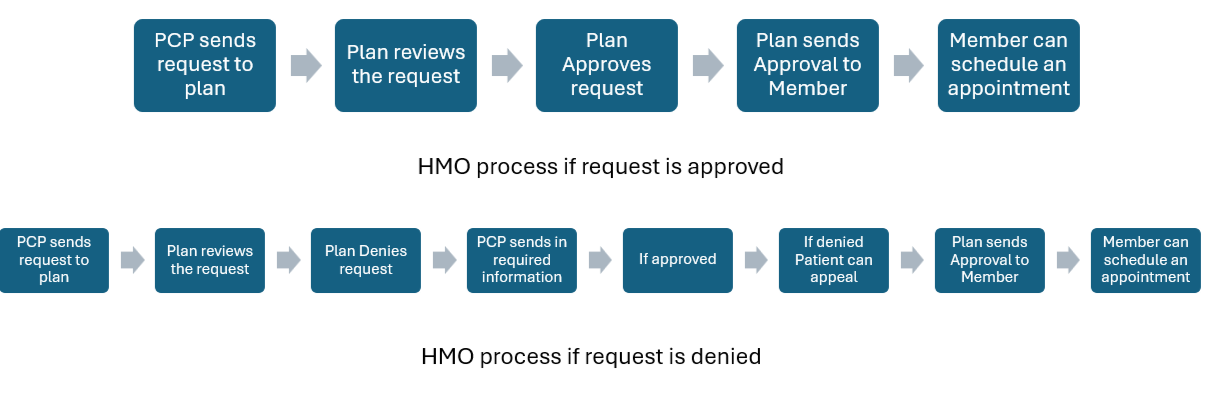
Example of Prior Authorization process
The final disadvantage that that Medicare Advantage plans have is something that feels like Medicare’s biggest secret. The loss of your one-time guaranteed acceptance into a Medicare Supplement Plan. Medicare Supplement Plans are plans that cover costs associated with original Medicare like the Part A deductible, Part A coinsurance, and Part B coinsurance. These plans are attractive to people on Medicare because it allows them to stay on Original Medicare while having a way to offset the costs that original Medicare comes with. Medicare Supplements use underwriting to evaluate the insurability of people applying. The main exception is when you initially begin your Part B coverage after which you have 6 months to purchase a plan. During this period, you have guaranteed acceptance into a plan. If you enroll in a Medicare Advantage plan during this period, you forfeit your guaranteed acceptance rights and joining a Medicare Supplement in the future can be difficult if you have health conditions.
While there are many drawbacks to having a Medicare Advantage Plan there are many benefits. This makes sense otherwise why would more than half of Medicare beneficiaries elect to enroll into one. The benefits are choosing a Medicare Advantage plan fall into three main categories: cost savings, an all-in-one package for health insurance, and extra benefits included in the plan.
The first reason many people on Medicare choose a Medicare Advantage (MA) plan is the cost savings that you can receive. Many plans have a $0 monthly premium which means in many cases joining a plan does not cost you anything. All MA plans have a Maximum-Out-of-Pocket limit which defines your health costs in one year. Furthermore, the plans lay out your coinsurance or co-payments for you every year, so you know how much to expect to pay for common services.
Apart from the possibility of saving money on your health insurance costs MA plans typically include drug coverage. This allows Medicare beneficiaries to get all their Medicare benefits; Part A, Part B, and Part D under one single plan. This helps simplify the process to get help since whether it is a drug coverage question or a medical coverage question it is all handled with one organization. This appeals to many people looking to simplify the often-confusing system that is Medicare.
One of the best-selling points about MA plans is the extra benefits that they offer. Many plans cover gym memberships, over-the-counter allowances, vision, and dental benefits. Dental and visions benefits are some of the most sought after benefits that people seek. As people age, vision and dental issues often grow and require more attention. Original Medicare does not offer any coverage for routine dental work. The same goes for vision, Medicare does not cover the cost of routine eye exams or glasses.
Medicare Advantage plans have both positives and negatives. As we talked about in the beginning, health insurance is not a one-size-fits -all product. Original Medicare does have significant coverage gaps that could be filled by a Medicare Advantage plan but before you join any plan there are many things to consider. Our dedicated team can help you navigate the complex options available to you so you can make the best choice.
[1] https://www.kff.org/medicare/medicare-advantage-in-2026-enrollment-update-and-key-trends/